
Receive God's Love, Proclaim the Greatness of the Lord, Serve Joyfully & Make Missionary Disciples of Jesus Christ
-
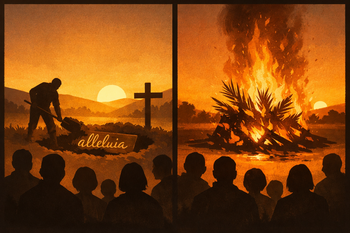
The Church has a remarkable way of teaching us through signs. Sometimes those signs are grand and unmistakable. Other times they are small customs that quietly shape how we enter into a season. Two beautiful traditions help us move from Ordinary Time into the penitential season of Lent: burying the Alleluia and burning last year’s palms.
Burying the Alleluia
Throughout most of the year, the word Alleluia is a constant companion to our prayer. It is the Church’s great shout of joy—an ancient Hebrew expression meaning “Praise the Lord!” We sing it before the Gospel, we hear it in hymns, and it appears again and again in the liturgy.
Then Lent begins, and suddenly it disappears.
The Church sets aside the Alleluia as a way of marking a change in tone. Lent is a season of repentance, reflection, and preparation. By fasting even from this joyful word, we become more aware of what we long to hear again.
In some places, parishes mark this transition with the custom of “burying” the Alleluia. A banner or plaque with the word may be processed out of the church, placed away, or even symbolically buried until it returns in triumphant song at the Easter Vigil. Its absence makes the heart grow fonder. And when the Alleluia bursts forth again at Easter, it feels earned, powerful, and new.
Burning the Palms
Another tradition connects one Lent to the next.
On Palm Sunday, we hold branches in our hands and join the crowd that welcomed Christ into Jerusalem. Over the year those palms are often kept in homes, tucked behind crucifixes or holy pictures as reminders of that celebration.
But what happens to them after a year has passed?
Rather than discarding a blessed object, the Church reverently burns the old palms. Their ashes are then used on Ash Wednesday to mark our foreheads with the sign of repentance: “Remember that you are dust…”
In this way, the triumphal entry of Jesus becomes the doorway to Lent. Celebration leads to conversion. The symbol comes full circle.
Neither of these practices is strictly required, yet both carry deep meaning. They remind us that liturgy is not only something we think about—it is something we experience with our senses and live with our bodies. We put away a word of joy so that we may hunger for its return. We burn the branches of welcome so that they may become the ashes of renewal. And through it all, the Church gently leads us toward Easter.
Join us on Monday February 16th at 6pm at the entrance of the church for a short service to do both of these customs. We hope to see you there.
RINCÓN DE LITURGIA
Enterrar el Aleluya y Quemar las Palmas
La Iglesia tiene una manera admirable de enseñarnos por medio de signos. A veces esos signos son grandes e inconfundibles. Otras veces son pequeñas costumbres que, silenciosamente, nos ayudan a entrar en un tiempo litúrgico. Dos hermosas tradiciones nos ayudan a pasar del Tiempo Ordinario al tiempo penitencial de la Cuaresma: enterrar el Aleluya y quemar las palmas del año pasado.
Enterrar el Aleluya
Durante la mayor parte del año, la palabra Aleluya es una compañera constante de nuestra oración. Es el gran grito de alegría de la Iglesia—una antigua expresión hebrea que significa: “¡Alaben al Señor!” La cantamos antes del Evangelio, la escuchamos en los himnos y aparece una y otra vez en la liturgia. Luego comienza la Cuaresma, y de repente desaparece. La Iglesia deja de lado el Aleluya para marcar un cambio de tono. La Cuaresma es un tiempo de arrepentimiento, reflexión y preparación. Al ayunar incluso de esta palabra tan gozosa, tomamos mayor conciencia de cuánto deseamos volver a escucharla. En algunos lugares, las parroquias señalan esta transición con la costumbre de “enterrar” el Aleluya. Un cartel o una imagen con la palabra puede salir en procesión del templo, guardarse o incluso enterrarse simbólicamente hasta que regrese en canto triunfal durante la Vigilia Pascual. Su ausencia hace que crezca nuestro deseo. Y cuando el Aleluya resuena de nuevo en Pascua, se siente merecido, poderoso y nuevo.
Quemar las Palmas
Otra tradición conecta una Cuaresma con la siguiente.
El Domingo de Ramos sostenemos las palmas en nuestras manos y nos unimos a la multitud que recibió a Cristo en Jerusalén. Durante el año, esas palmas suelen guardarse en casa, colocadas detrás de un crucifijo o una imagen sagrada como recuerdo de aquella celebración. Pero, ¿qué sucede después de que ha pasado un año? En lugar de tirar un objeto bendecido, la Iglesia quema respetuosamente las palmas viejas. Sus cenizas se utilizan el Miércoles de Ceniza para marcar nuestras frentes con el signo del arrepentimiento: “Recuerda que eres polvo…” De esta manera, la entrada triunfal de Jesús se convierte en la puerta hacia la Cuaresma. La celebración conduce a la conversión. El símbolo se completa.
Ninguna de estas prácticas es estrictamente obligatoria, pero ambas tienen un profundo significado. Nos recuerdan que la liturgia no es solo algo que pensamos, sino algo que experimentamos con los sentidos y vivimos con nuestro cuerpo. Guardamos una palabra de alegría para desear más intensamente su regreso. Quemamos las ramas de bienvenida para que se conviertan en cenizas de renovación. Y en todo ello, la Iglesia nos guía suavemente hacia la Pascua.
Acompáñenos el lunes 16 de febrero a las 6 p.m. en la entrada del templo para un breve servicio en el que realizaremos estas dos tradiciones. Esperamos verlos allí.