
Receive God's Love, Proclaim the Greatness of the Lord, Serve Joyfully & Make Missionary Disciples of Jesus Christ
-
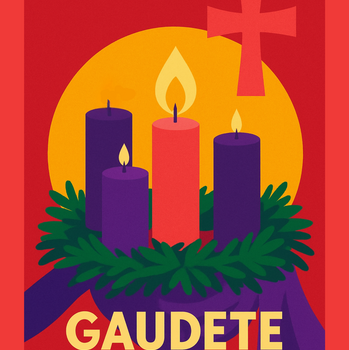
One of the most noticeable features of the Advent wreath is the rose-colored candle. Why is it different, and why might your priest wear pink vestments on that day? The third Sunday of Advent is called Gaudete Sunday, and it is marked by the use of rose—a color symbolizing joy in the midst of a penitential season.
Historically, Advent was observed with greater austerity than most Catholics experience today. In the medieval Church, fasting or abstinence was practiced on many days, and Fridays (and in many places Wednesdays) were customary penitential days. Friday abstinence continued broadly into the 20th century and, although still encouraged year-round, is no longer universally obligatory outside of Lent in many regions.
Liturgically, Advent is meant to have a restrained character. Traditionally, instrumental music was limited to supporting singing rather than being used alone, signaling a quieter, more reflective tone. While many parishes today make only subtle distinctions between Advent and Ordinary Time, the season has long carried a more penitential musical atmosphere. Gaudete Sunday stands out as an exception—a day when the tone lifts, music grows more expressive, and the Church invites us to rejoice.
The name Gaudete comes from the Entrance Antiphon of the day, which begins Gaudete in Domino semper (“Rejoice in the Lord always”). The full text—drawn from Philippians 4 and Psalm 85—reads:
Rejoice in the Lord always; again I say, rejoice.
Let your forbearance be known to all, for the Lord is near at hand. Have no anxiety about anything, but in all things, by prayer and supplication, with thanksgiving, let your requests be made known to God. Lord, you have blessed your land; you have turned away the captivity of Jacob.While much of the scripture readings of Advent focus on repentance and preparation for Christ’s return, Gaudete Sunday highlights joyful anticipation of His coming in the Nativity. So on this day, let your joy be seen—and again I say: rejoice! And if you’re inclined, you might even wear a cheerful shade of rose (or pink!).
RINCÓN LITÚRGICO
Domingo de Gaudete — ¡Alégrense!
Una de las cosas más llamativas de la corona de Adviento es la vela de color rosa. ¿Por qué es diferente? ¿Y por qué quizá el sacerdote use vestiduras de color rosado en ese día? El tercer domingo de Adviento se conoce como Domingo de Gaudete, y se distingue por el uso del color rosa, símbolo de la alegría dentro de un tiempo penitencial.
Históricamente, el Adviento se vivía con mayor austeridad que la que experimentamos hoy. En la Iglesia medieval se practicaba el ayuno o la abstinencia varios días de la semana, y los viernes (y en muchos lugares también los miércoles) eran días penitenciales habituales. La abstinencia de los viernes se mantuvo de manera generalizada hasta bien entrado el siglo XX y, aunque todavía se recomienda durante todo el año, ya no es obligatoria fuera de la Cuaresma en muchas regiones.
Litúrgicamente, el Adviento conserva un carácter de sobriedad. Tradicionalmente, la música instrumental se usaba solo para acompañar el canto, y no de manera independiente, dando al ambiente un tono más discreto y contemplativo. Aunque hoy en muchas parroquias la diferencia entre Adviento y el Tiempo Ordinario es poco marcada, la Iglesia ha visto siempre este tiempo con un espíritu más penitencial. El Domingo de Gaudete es la gran excepción: un día en el que el tono se eleva, la música puede ser más alegre y la Iglesia nos invita a regocijarnos.
El nombre Gaudete proviene de la Antífona de Entrada de ese domingo, que comienza Gaudete in Domino semper (“Alégrense siempre en el Señor”). El texto completo —tomado de Filipenses 4 y el Salmo 85— dice:
Alégrense siempre en el Señor; se lo epito: ¡alégrense! Que su amabilidad sea conocida por todos, porque el Señor está cerca. No se inquieten por nada; más bien, en toda situación, presenten sus peticiones a Dios con oración, súplica y acción de gracias. Señor, tú has bendecido tu tierra; has liberado a Jacob de su cautiverio.
Mientras que muchas de las lecturas de Adviento invitan a la conversión y a prepararnos para el regreso de Cristo, el Domingo de Gaudete nos hace mirar con alegría la pronta llegada de su nacimiento. Así que en este día, deja que tu alegría resplandezca y —como dice la Escritura— ¡alégrate! Y si lo deseas, también puedes vestir un tono alegre de color rosa.