
Receive God's Love, Proclaim the Greatness of the Lord, Serve Joyfully & Make Missionary Disciples of Jesus Christ
-
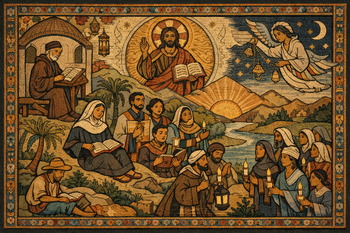
You may not be familiar with the term Breviary, but it is the essential tool of the other great liturgy of the Church—the Liturgy of the Hours (also known as the Divine Office). Working as dynamic partners, the Liturgy of the Hours and the Liturgy of the Eucharist (Mass) provide ceaseless prayer across the world. We have covered how the Roman Missal, the Lectionary, and the Book of the Gospels function within Mass. The Breviary is the catch-all term for the books or volumes that contain and direct the prayer of the Liturgy of the Hours.
The term breviary comes from the Latin breviarium, meaning a shortened or condensed volume. (This is somewhat ironic, because the actual books are quite thick.) The earliest breviaries gathered all the elements of the Divine Office into a single place for ease of reference and use. Prior to this, texts came from various sources or from the memory of those who prayed them.
The Liturgy of the Hours includes Scripture readings, prayers, writings from the Fathers and Doctors of the Church, and—most significantly—the 150 Psalms. Over a defined span of time, all of the psalms are prayed. For different communities and at different moments in history, the number of days in the cycle has varied. In many monastic communities, the psalter is completed in one week; in the post–Vatican II Church, it is arranged in a four-week cycle. The breviary guides this rhythm of prayer.
Since 2012, a new translation of the Liturgy of the Hours for the United States has been underway, with final approval granted in October 2025. Optional use will begin in February 2027, and the new edition will become obligatory for those who are required to pray the Hours beginning in Advent 2028. This translation is intended to raise the profile of the Liturgy of the Hours among the laity and to provide texts that are better suited for singing and more closely aligned with the original Latin.
Navigating the breviary can be challenging—arguably even more so than the Roman Missal—with its four-week psalm cycle, multiple daily Hours, and adjustments for liturgical seasons and feast days. For many people, a digital resource can make personal prayer more approachable. Two straightforward options are iBreviary.com and DivineOffice.org .
If you want to begin praying the Hours on your own, the principal Hours that clergy are bound to pray each day are the Office of Readings, Morning Prayer, and Evening Prayer. These can be longer, so other Hours—like Night Prayer—may be an easier place to start. Although clergy and many religious are obligated to pray the Hours, this prayer belongs to the entire Church. Whenever a layperson opens the breviary—alone or in common—they participate in the public prayer of Christ and His Body. May our encounter with the Breviary and the Liturgy of the Hours help sanctify the time of each day.
RINCÓN DE LITURGIALibros Litúrgicos: El Breviario
Tal vez no esté familiarizado con el término Breviario, pero es la herramienta esencial de la otra gran liturgia de la Iglesia: la Liturgia de las Horas (también conocida como el Oficio Divino). Como compañeros dinámicos, la Liturgia de las Horas y la Liturgia de la Eucaristía (la Misa) ofrecen una oración incesante en todo el mundo. Hemos hablado de cómo el Misal Romano, el Leccionario y el Evangeliario funcionan dentro de la Misa. El Breviario es el nombre general que se da a los libros o volúmenes que contienen y dirigen la oración de la Liturgia de las Horas.
El término breviario proviene del latín breviarium, que significa un volumen abreviado o condensado. (Esto es algo irónico, porque los libros en realidad son bastante gruesos). Los primeros breviarios reunieron todos los elementos del Oficio Divino en un solo lugar para facilitar su consulta y uso. Antes de esto, los textos provenían de diversas fuentes o de la memoria de quienes los rezaban.
La Liturgia de las Horas incluye lecturas de la Sagrada Escritura, oraciones, textos de los Padres y Doctores de la Iglesia y—de manera muy especial—los 150 salmos. A lo largo de un período determinado se rezan todos los salmos. Para distintas comunidades y en diversos momentos de la historia, el número de días del ciclo ha variado. En muchas comunidades monásticas el salterio se completa en una semana; en la Iglesia posterior al Concilio Vaticano II está organizado en un ciclo de cuatro semanas. El breviario guía este ritmo de oración.
Desde el año 2012 se ha trabajado en una nueva traducción de la Liturgia de las Horas para los Estados Unidos, la cual recibió su aprobación final en octubre de 2025. Su uso opcional comenzará en febrero de 2027, y será obligatorio para quienes están comprometidos a rezar el Oficio a partir del Adviento de 2028. Esta traducción busca dar mayor impulso a la participación de los fieles laicos y ofrecer textos más adecuados para el canto y más cercanos al latín original.
Navegar el breviario puede ser complicado—quizás incluso más que el Misal Romano—con su ciclo de salmos de cuatro semanas, las varias Horas del día y los cambios según el tiempo litúrgico y las fiestas. Para muchas personas, un recurso digital puede hacer que la oración personal sea más accesible. Dos opciones sencillas son iBreviary.com y DivineOffice.org.
Si desea comenzar a rezar las Horas por su cuenta, las principales Horas que el clero está obligado a rezar cada día son el Oficio de Lecturas, Laudes (Oración de la Mañana) y Vísperas (Oración de la Tarde). Estas pueden ser más largas, por lo que otras Horas—como Completas (Oración de la Noche)—pueden ser un punto de partida más sencillo. Aunque el clero y muchos religiosos tienen la obligación de rezarlas, esta oración pertenece a toda la Iglesia. Cada vez que un laico abre el breviario—solo o en comunidad—participa en la oración pública de Cristo y de su Cuerpo.
Que nuestro encuentro con el Breviario y la Liturgia de las Horas nos ayude a santificar el tiempo de cada día.