
Receive God's Love, Proclaim the Greatness of the Lord,
Serve Joyfully & Make Missionary Disciples of Jesus Christ
-
 January 13, 2026
If you were asked to name the most important book used at Mass, many would instinctively answer the Bible. That instinct is not wrong—but it is incomplete. Alongside the Lectionary and the Book of the Gospels sits another book that quietly shapes every Mass we celebrate: the Roman Missal.
The Roman Missal is not a book of readings. Rather, it is the Church’s book of prayer for the Mass. Every presidential prayer, dialogue, acclamation, and instruction that frames our worship is drawn from its pages. When the priest says, “Let us pray,” when he chants the Collect, when the Eucharistic Prayer unfolds, when the Church gives voice to thanksgiving and petition—these words come from the Missal. In this sense, the Roman Missal is the Church praying out loud.
The Roman Missal includes:
The Order of Mass, including the dialogues between priest and people
The presidential prayers (Collect, Prayer over the Offerings, Prayer after Communion)
The Eucharistic Prayers
The proper prayers for each day of the liturgical year
Rubrics—those often-overlooked instructions printed in red—that guide how the liturgy is celebrated
These prayers are not improvised. They are received, preserved, translated, and handed on. The Missal gives the Church a shared voice, ensuring that whether Mass is celebrated in a cathedral, a parish church, or a hospital room, it is recognizably the same prayer of the same Church.
The Roman Missal did not drop from the sky fully formed. Its prayers represent centuries of theological reflection, scriptural meditation, and pastoral experience. Many of the Collects we hear on Sundays are ancient—some tracing their roots to the early centuries of Christianity. Their compact language, rich imagery, and careful theology are intentional. Nothing is wasted. Every word matters.
Following the Second Vatican Council, the Missal was revised to restore older texts, expand the prayer options, and more clearly express the Church’s theology of the Mass as both sacrifice and sacred meal. More recently, the English translation was revised to more faithfully reflect the Latin original—not to make the prayers harder, but to make them deeper.
Though it is a fixed text, the Roman Missal is not static. It moves with the rhythm of the liturgical year, shifting tone from Advent longing to Christmas joy, from Lenten repentance to Easter triumph, from Ordinary Time’s steady discipleship to the feasts that punctuate our calendar. It teaches us that prayer changes with the seasons of salvation history—and with the seasons of our lives.
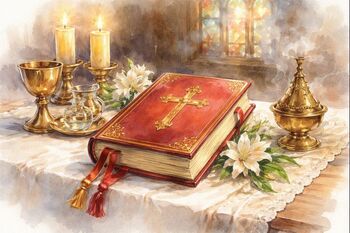
Each time the Missal is opened at the altar, the Church does what it has always done: it lifts its voice to God, trusting that these carefully chosen words will carry the faith of the people who pray them. It is, quite simply, the Church at prayer—bound in red and gold, proclaimed in faith, and sealed with a quiet but resolute Amen.